The cost vs. conversion reality
Let us talk about the elephant in the festive room: rising media costs.
Every year between September and November, digital advertising turns into a high-stakes auction. Brands flood Meta, Google and the retail-media networks with heavy budgets, and prices climb. The sharpest inflation now sits in retail media: industry executives estimate premium quick-commerce placements, homepage banners, category takeovers and top-of-search, run 30% to 40% above a normal month during Diwali, with some estimates reaching 50%.
Here is the hard truth. If you run the same broad-targeting campaigns during Diwali that you run in March, you are overpaying for every sale. Winning the festive rush comes down to allocating budget with extreme precision rather than out-spending the competition.
This paper maps performance strategies across five core consumer sectors, then closes with a section on generative AI and LLM visibility, so your brand captures share inside the answer engines buyers now use to decide.

FMCG &
Packaged Goods
Impulse at ten-minute speed: quick commerce will become a core festive distribution channel in 2026.
Map my quick-commerce plan →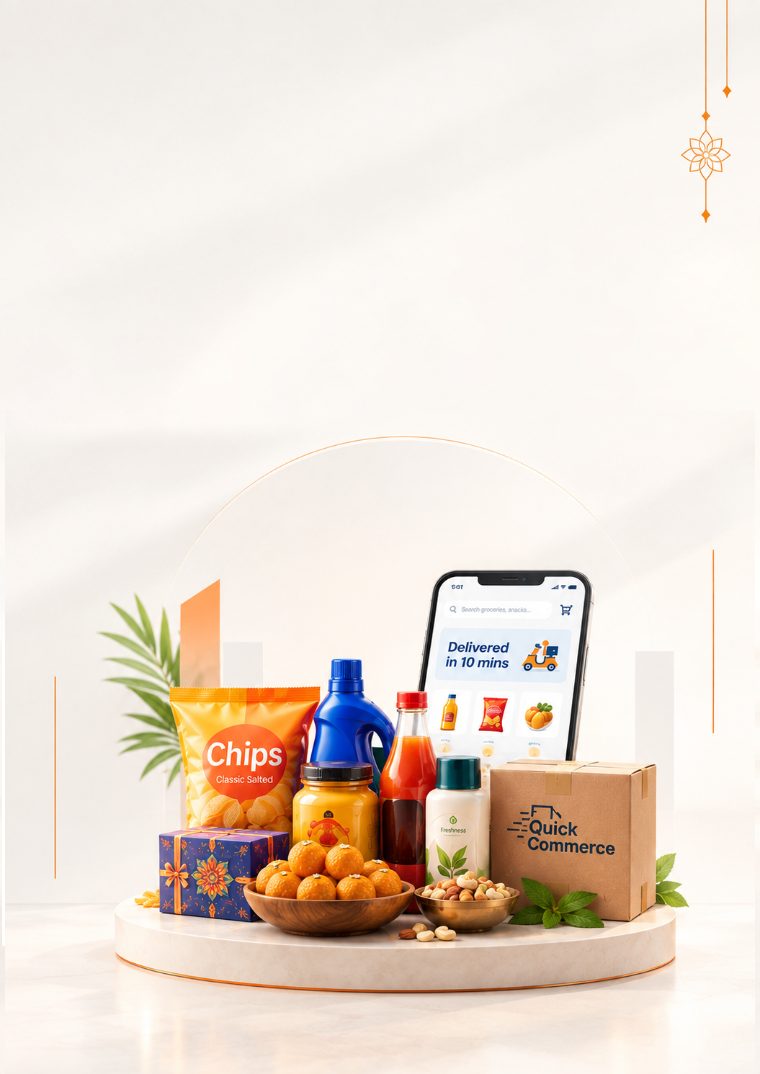
What is happening in the market
Have you noticed how far consumer expectations have moved? The days of planning the Diwali grocery run several days in advance are fading. Today's urban Indian shopper expects mithai boxes, party snacks, last-minute pooja essentials and personal-care gifts at the door in ten minutes or less.
Quick-commerce platforms such as Blinkit, Zepto and Swiggy Instamart have gone from modern luxury to core retail distribution. Redseer described quick commerce as India's fastest-growing retail format, with 33 million monthly transacting users across more than 150 cities as of July 2025.
“An FMCG brand with no link to high-speed fulfilment is leaving impulse sales on the table.”
1×
~3.5×
Performance benchmarks and what they mean
Your festive action plan
Short, fast-cut video built in regional languages. Lead with multi-pack festive gift boxes and explicit express-delivery messaging such as “delivered to your party in 10 minutes”.
Reallocate up to 40% of bottom-of-funnel budget into the final 72-hour window before major festival days, against a 20% seasonal baseline. Quick commerce runs 20–30% of budgets, rising to 30–40% at festive peak.
Instant order rate and 60-day repeat purchase rate.
Automotive
A Dhanteras tradition, now shaped by weeks of digital research before the showroom.
Plan my dealership campaigns →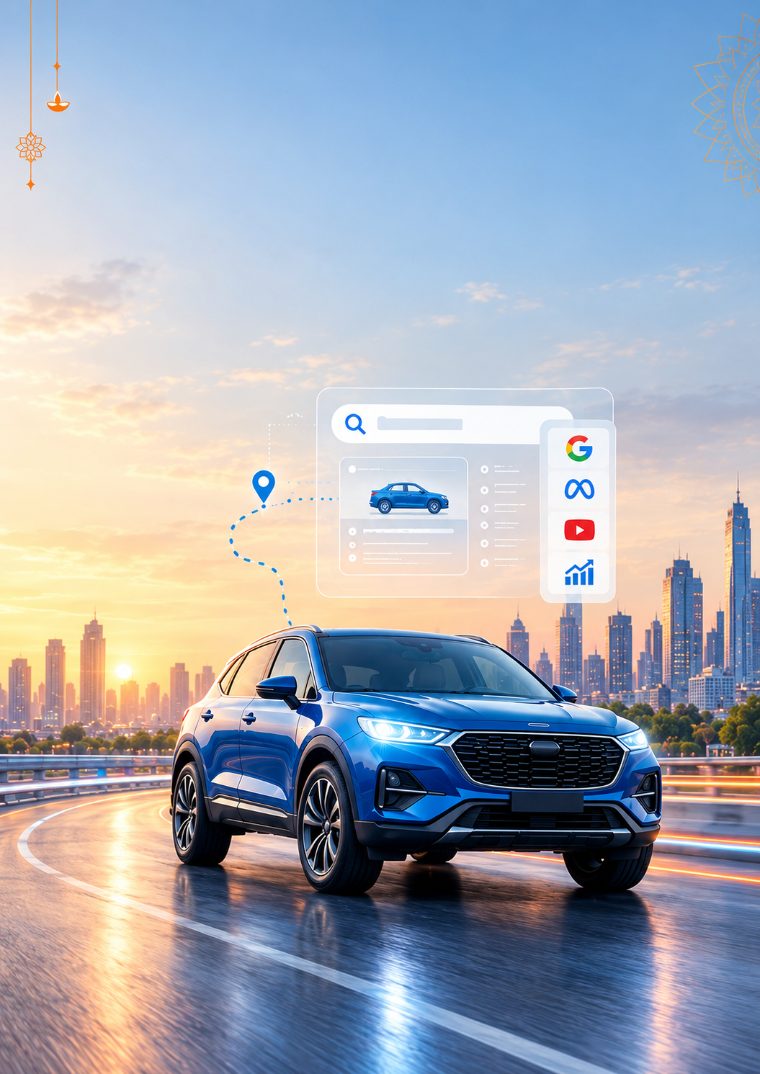
What is happening in the market
Buying a car or two-wheeler on Dhanteras or Diwali is woven into Indian cultural tradition. It signals family prosperity, financial progress and long-term investment. What has changed is the path to the showroom.
FADA reported vehicle retails up 21% year on year across the 42-day festive period of 2025, against 11.76% growth in 2024, both measured through Vahan registrations rather than factory dispatches, so they reflect what buyers actually took home. Before buyers walk into a dealership, they spend weeks researching models online, comparing safety ratings, calculating EMIs and reading reviews.
“Your paid media has to bridge digital curiosity and a physical showroom visit.”
+11.8%
+21%
Performance benchmarks and what they mean
The FADA figures below describe the same 42-day festive window: overall vehicle retail growth and passenger-vehicle growth within it.
Your festive action plan
Interactive 3D previews and 360-degree exterior views built around limited festive colour editions, zero-down-payment offers and immediate delivery timelines. Front-load styling, offer and call to action into the opening seconds of video.
Hyper-local Google Performance Max campaigns inside a 10km radius of dealership hubs, paired with Meta instant lead forms wired directly into your CRM.
Cost per verified showroom visit and validated test-drive lead rate.
Gifting &
Seasonal Products
A large market changing shape, not growing fast, won on share, not category lift.
Build my gifting funnel →
What is happening in the market
Festive gifting in India is a large market that is changing shape rather than growing fast. TechSci Research valued it at $75.16 billion in 2024, reaching $92.32 billion by 2030, a compound annual growth rate of just 3.55%. That number matters for how you plan: category growth will not carry your festive target. Share has to be taken from competitors, or value built through premiumisation and higher basket sizes.
During Diwali, corporate buyers ordering hundreds of client sets sit alongside individual shoppers buying last-minute family gifts. Shoppers add to cart, compare across a dozen open tabs and hesitate over delivery promises. Your paid strategy has to pair creative personalisation with real-time urgency.
“Category growth will not carry your target. Share has to be taken.”
Performance benchmarks and what they mean
Your festive action plan
Dynamic carousel ads with live delivery countdowns such as “order within 3 hours for guaranteed Diwali delivery”, paired with interactive gift-bundle selectors.
Broad prospecting from 14 days out. At 72 hours, increase investment in dynamic catalogue retargeting and automated WhatsApp reminders.
Blended return on ad spend and average order value. In a 3.55% CAGR category, AOV is the lever that moves your number.
E-commerce
& Direct-to-Consumer
More shoppers, more orders and tougher competition for every sale.
Scale my D2C festive spend →
What to expect in 2026
India's festive e-commerce sales are projected to reach ₹1.50–₹1.55 lakh crore in 2026, growing 25% to 29% over 2025. Quick commerce is expected to account for 16% of festive online sales, up from 12% last year.
Much of this growth will come from beyond the major metros. Bain estimates that Tier 2 and smaller cities contributed approximately half of India's incremental e-retail orders in 2025, making regional reach, language and payment preferences increasingly important in 2026.
As platforms, marketplaces and brands increase their festive investment, competition for high-intent shoppers will intensify. Keeping acquisition costs under control will require stronger creative, credible social proof, accurate product feeds and first-party conversion data flowing back into the platforms.
“Festive e-commerce sales could reach ₹1.50–₹1.55 lakh crore in 2026.”
Performance benchmarks and what they mean
Your festive action plan
Creator-led unboxing video, authentic user reviews and direct side-by-side product comparisons that build purchase confidence fast.
Meta Advantage+ sales campaigns alongside Google Performance Max, with the Meta Conversions API feeding real-time offline purchase data back into the platforms.
Cost per acquisition and festive customer lifetime value. Track prepaid share alongside both, since COD returns erode reported ROAS.
Consumer Durables
Long research cycles, high tickets, and where online and offline collide most sharply.
Plan my omnichannel push →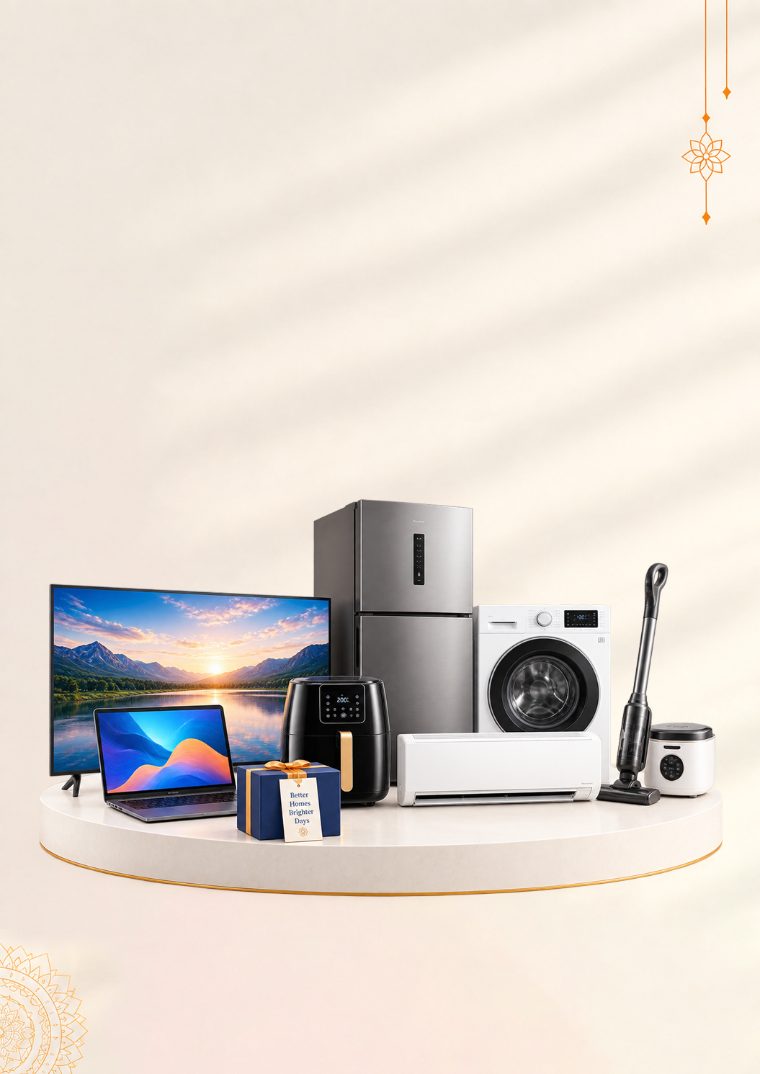
What is happening in the market
When an Indian family decides on a 65-inch smart TV, a double-door refrigerator or a premium washing machine during Diwali promotions, impulse rarely comes into it. Durables purchases carry long research cycles, high ticket sizes and collective family evaluation.
The sector is also where online and offline collide most sharply. NielsenIQ puts online channels at about 34% of consumer-electronics sales in India, which means two-thirds of the money still changes hands in a store. Your advertising has to stay present across search and local retail touchpoints for the whole evaluation window, not just the checkout.
“Two-thirds of the money still changes hands in a store.”
Performance benchmarks and what they mean
Your festive action plan
Answer the practical questions directly: energy efficiency, multi-year warranty, festive cashback and instant no-cost EMI approval steps.
Capture exact-match brand keywords on Google Search, and run Google Local Inventory Ads to push digital shoppers into nearby retail partner stores.
Three weeks or longer. High-ticket appliance buyers stay in active comparison well past the standard 7 to 14 days most platforms default to.
Combined e-commerce sales and verified retail store footfall.
Generative AI & LLM Visibility
The shift from keywords to conversation, and why paid performance now has to live inside the answer engines.
Audit my AI visibility →The shift from keywords to conversation
How do you search for a festive purchase today? Blue-link search is still widely used, but high-intent shoppers are increasingly running complex shopping decisions through ChatGPT, Gemini and Perplexity. MiQ's Festive Shopper Insights 2026 survey of more than 5,700 Indian shoppers found that 43% use AI-powered search for brand discovery, making it the leading discovery channel in that study.
Instead of typing “best microwave oven”, buyers now write out the whole brief: compare the top three convection microwave ovens under ₹15,000 in India with festive bank discounts, long warranties and low power usage. If your catalogue is not cited or recommended inside those answers, you are absent at the exact moment the buyer decides.
Track Share of Voice and Unique Citations and Citation Share alongside your standard cost per click and ROAS. These are Tesseract measures, not industry-standard metrics, so define them for your stakeholders before you report against them.
Protect media margin while growing revenue through the year's most expensive quarter
Scaling performance marketing through the Indian festive season takes a multi-platform media strategy. Connect quick commerce, high-intent search formats, sector-specific creative and conversational AI visibility, and your brand protects media margin while growing revenue.
One caution runs through every sector in this paper. Festive 2025 was lifted in affected categories by GST 2.0 rate cuts, which took effect at the start of the main Navratri-to-Diwali window and released deferred demand across autos, appliances and durables. Use 2024 and 2025 as reference cases rather than treating either year as an automatic baseline for 2026.
Plan your festive paid campaign today
Tell us where your festive budget is going and we'll map it against every benchmark in this report, then return a channel-by-channel allocation model from AdLift, supported by the relevant measurement inputs.