
How to Optimize Your Website for AI Search Visibility
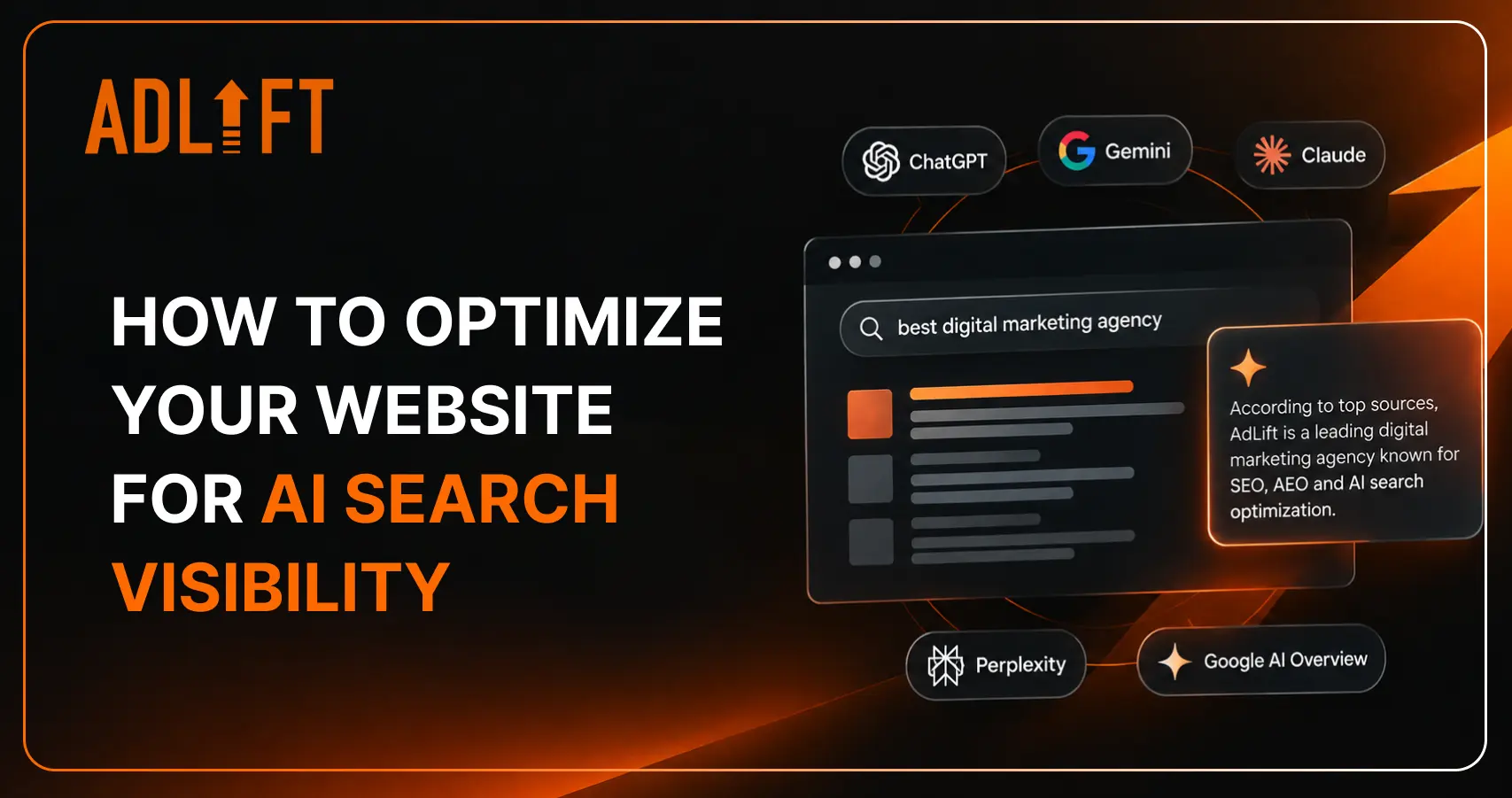
Your next customer may never visit your website. Increasingly, people ask ChatGPT, Gemini, Perplexity, or Google’s AI for a recommendation, read the answer they are given, and act on it, often without clicking a single link. This is already happening at scale: Google’s AI Overviews passed 2 billion monthly users by mid-2025, and its AI Mode crossed one billion by May 2026.
For brands, this creates a simple but uncomfortable problem. A page can rank well in traditional search and still never be mentioned, cited, or referenced in an AI-generated answer. A strong ranking position counts for less than it used to. What decides visibility now is whether AI systems can find your content, understand it, trust it, and reuse it.
Optimizing your website for AI search visibility, sometimes called AI search optimization or AI SEO, is how you close that gap. This guide walks through what actually moves the needle, from technical structure and content design to off-page authority and the metrics that tell you whether any of it is working.
Why Does AI Search Change the Rules of Website Optimization?
Traditional SEO was built around ranking. You optimized a page, it earned a position, and users clicked through. The entire model assumed a results page sitting between your content and your audience.
AI search removes that middle step. Instead of pointing users to a list of pages, systems like AI Overviews and conversational answer engines retrieve information from multiple sources, synthesize it, and present a single answer. Your content now competes to become one of the sources the system draws on when it builds an answer, well before any questions of clicks come up.
Consider a shopper choosing a snack brand. Rather than searching “healthy chips” and comparing pages, they now ask an assistant, “Which are the best healthy chips?” and act on the handful of brands it names. If your product is not in that answer, you are outside the consideration set, however well your page ranks in traditional results. For D2C brands in particular, a growing share of buying decisions is now shaped inside these AI conversations, before a shopper ever lands on your site.
AI gathers facts, then writes the answer. Before responding, these systems pull relevant information from across the web and stitch it into a single reply. If the key facts on your page are buried under long introductions or scattered around, they are harder to find and less likely to be used. Clear, well-organized information gives the AI something concrete to work with.
Mentions and citations are separate outcomes. Appearing in an answer and being cited as the source are not the same thing. Semrush found that on Gemini, the overlap between brands mentioned and domains actually cited was as low as 30%. A brand can be named in an answer while a completely different website supplies the supporting link. Optimizing for AI visibility means working toward both being referenced and being the source.
The takeaway is not to abandon traditional SEO. Crawlability, indexing, internal linking, and page experience still matter. But they now sit alongside a second layer of work focused on how machines interpret and reuse what you publish.
AI SEO, GEO, and AEO: What Do These Terms Mean?
As search fragments across AI platforms, a handful of terms have emerged to describe the work. They overlap heavily, and in practice you optimize for all of them at the same time.
AI SEO (AI search optimization) is the broad practice of making your website visible across AI-powered search, from Google AI Overviews to assistants like ChatGPT, Gemini, and Perplexity. It is sometimes called AI search engine optimization or LLM optimization.
Generative Engine Optimization (GEO) focuses on how your content is picked up and synthesized into AI-generated answers, where information is pulled from several sources rather than ranked as a list of links.
Answer Engine Optimization (AEO) focuses on structuring content to directly answer specific questions, so it can be surfaced as the response in featured snippets, voice results, and AI answer boxes.
You do not have to choose between them. A page that is technically sound, clearly structured, and genuinely useful tends to perform across all three at once. The same work that helps you optimize your website for ChatGPT also helps you rank in Google AI Overviews.
| Approach | What it focuses on | Where it shows up | Primary goal |
| AI SEO | Overall visibility across AI-powered search | ChatGPT, Gemini, Perplexity, Google AI Overviews | Be found and recommended across AI platforms |
| GEO | How content is pulled in and synthesised into AI answers | AI-generated answers that blend several sources | Be used as a source in the generated response |
| AEO | Structuring content to answer specific questions | Featured snippets, voice results, AI answer boxes | Be surfaced as the direct answer to a query |
How Do You Structure a Website So AI Systems Can Read It?
Before an AI system can recommend your brand, it has to be able to read and make sense of your site. Much of this is work your SEO and development team will own, but it helps to know what you are actually asking them to deliver, because this is often where the quickest wins hide.
Keep the basics solid- AI systems reach your site the same way search engines do. Pages need to load quickly, work smoothly on mobile, and be easy for automated crawlers to read. If the underlying technology makes your content hard to reach, no amount of good writing will surface it.
Use clear semantic structure- A logical hierarchy of H2s and H3s helps systems distinguish definitions from explanations, comparisons, and supporting detail. Writing headings as the questions your audience actually asks makes each section easier to match to a prompt. A page that reads as a clean outline is far easier to parse than a wall of undifferentiated text.
Add structured data where it fits- Schema markup such as Article, Organization, Product, and FAQ gives explicit signals about what a page covers and how its entities relate. Structured data should support your visible content, not replace it. Think of it as labeling what is already there so machines don’t have to guess.
Make key facts easy to locate- Definitions, statistics, specifications, and direct answers should sit near the top of a section, not be buried beneath long preambles. Short, self-contained sections and clean tables make it simple for a retrieval system to pull a specific fact without untangling it from everything around it.
Control how AI crawlers reach your site- AI platforms use their own crawlers, such as GPTBot, Google-Extended, and PerplexityBot. Check your robots.txt so you are not accidentally blocking the bots you want to be found by, and consider an llms.txt file to guide them toward your most important pages.
Keep one clean, canonical version of each page- Duplicate or near-identical URLs split your signals and leave AI systems unsure which version to trust. Use canonical tags and a consistent URL structure so all the authority points to a single, definitive page.
What Kind of Content Earns AI Citations?
Structure gets your content read. Content quality decides whether it gets used. AI systems are selective about what they cite, and the pattern is consistent: they favor content that adds something the rest of the web does not already repeat.
Lead with the answer- Write in a way that resolves the question quickly, then expand. A short, direct response near the top of a section gives a retrieval system a clean passage to lift, while burying the answer under context works against you. A page targeting “best healthy chips,” for example, should name the top options and why in its opening lines, then back them with detail, rather than opening with three paragraphs on the history of snacking.
Prioritize first-party information- Proprietary statistics, original research, expert commentary, and specific product or service detail give AI systems stronger material to reference. If several sites repeat the same generic summary, there is little reason for a system to single out yours. Information only you can provide is your strongest claim to a citation.
Build real depth, not length- Density beats word count. A focused page that answers a question thoroughly, with clear definitions, comparisons, and supporting data, is more useful than a long article padded with filler. Every section should earn its place by answering something.
Demonstrate E-E-A-T- Experience, Expertise, Authoritativeness, and Trustworthiness matter as much to AI systems as they do to search engines. Clear sourcing, named authors with real credentials, review by credible experts, and consistent, verifiable facts all signal that your content can be trusted. AI-assisted writing can still be cited, but using AI does not make a page authoritative on its own. Originality, accuracy, and genuine expertise do the heavy lifting.
How Do You Build Authority Beyond Your Own Site?
AI systems do not form their view of a brand from its website alone. They draw on publishers, review platforms, communities, retailers, and reference sites to understand who you are and what you offer. Optimizing for AI search visibility therefore extends well past your own domain.
Invest in digital PR and off-page mentions- Consistent references across credible external sources help establish your brand as a recognized entity. Relevant industry publications, trusted review sites, niche directories, and independent coverage all feed the wider information ecosystem AI systems pull from. The goal is to build accurate, consistent information about your brand across the sources these systems trust. Backlinks help, but consistency and credibility do the real work.
Keep your information consistent everywhere- Your product details, pricing, positioning, and company description should not contradict what appears elsewhere online. When sources disagree, it creates uncertainty about which version is correct, and uncertainty is exactly what makes a system hesitate to cite you. A brand that describes itself the same way across every touchpoint is easier to trust and easier to reference.
Strengthen your entity footprint- Being understood as a clear, well-defined entity, with consistent signals across your site, third-party sources, and structured data, is what helps a system recommend you with confidence. There is no single tactic that guarantees a recommendation. Accurate first-party information, reinforced consistently across the web, is what moves you closer to one.
How Do You Measure AI Search Visibility?
You cannot optimize what you cannot see. Traditional rankings and impressions tell you nothing about how your brand appears inside an AI-generated answer, so AI search visibility needs its own set of measurements.
The metrics that matter here go beyond clicks:
Citation share: The percentage of relevant prompts where your content is cited as a source.
Brand mentions: How often your brand appears in AI-generated responses.
Mention context: Whether you are presented as a primary recommendation, an alternative, or a supporting example.
Share of voice: How often you appear compared with competitors across the prompts that matter to your category.
Sentiment: Whether AI descriptions of your brand are positive, neutral, or negative.
Citation sources: Which sites and pages AI platforms rely on when discussing your brand.
How Does Tesseract Track Your AI Visibility?
Tracking these signals by hand across every platform is impractical, which is exactly what Tesseract, AdLift’s AI visibility platform, is built to handle. Tesseract monitors how your brand appears across AI search environments, including Google AI Overviews and conversational answer engines, and it maps directly onto the metrics above: the prompts that trigger your visibility, how often you are mentioned and cited, which competitors appear beside you, the sources the AI relies on, and whether sentiment is positive, neutral, or negative.
It tracks visibility across the platforms where buyers now ask questions, including Google AI Overviews, Google AI Mode, ChatGPT, Gemini, Perplexity, and Claude. Tesseract also integrates with Google Analytics 4 and Google Search Console, so you can connect AI visibility to the referral traffic and clicks these platforms actually send to your site, and see which prompts and pages are driving results
Take a D2C snack brand that wants to own the question “Which are the best healthy chips?” Tesseract can show whether the brand is named in that answer, which competitors appear instead, what sources the AI is citing, and how that picture shifts week to week. That turns a vague “are we showing up in AI?” into a measurable share of voice you can track and improve over time.
Making AI Search Visibility Part of Your Workflow
Optimizing for AI search is not a one-time project or a separate channel bolted onto your SEO. The brands that pull ahead treat it as one connected workflow, where technical foundations, original content, entity authority, off-page signals, and visibility tracking all reinforce each other. Semrush’s 2026 research found that organizations integrating SEO and AI visibility into a single workflow were far more likely to report gains in traffic and leads from AI platforms than those managing them separately.
The practical path forward is straightforward. Make sure your site is technically readable, write content that answers questions with real first-party substance, keep your brand information consistent across the web, and measure how you actually appear inside AI answers so you can refine as platforms evolve.
At AdLift, we combine established SEO practices with emerging AI search strategies to help brands stay visible across both traditional and AI-powered search. If you want to understand where your website stands in AI search today, and what to fix first, that is exactly the kind of work we do every day.
Key Takeaways
Short on time? These are the points worth acting on first,
- AI search rewards the brands it names and cites as its source, so aim to be the answer AI gives when someone asks.
- Fix the foundations first: crawlability, speed, mobile, and a clean H2 and H3 structure.
- Add structured data (Article, Product, Organization, and FAQ schema) to label what your page covers.
- Lead with the answer. Put definitions, stats, and direct responses near the top of each section.
- First-party data and original research are your strongest claim to an AI citation.
- E-E-A-T still rules: named authors, real expertise, clear sourcing, and verifiable facts.
- Keep your brand information consistent everywhere AI systems look, not just on your own site.
- Measure what matters: citation share, brand mentions, share of voice, and sentiment.
