Best AI SEO Tools to Boost Rankings in 2026
Your website might already be invisible, and you do not even know it. In 2026, AI is silently deciding who gets noticed and who disappears online. Focus beyond keywords and backlinks because AI now reads user intent, content context, and engagement patterns before showing results.
AI search traffic has soared by more than 527% year over year as users shift from traditional search to AI-driven discovery, leaving top Google rankings powerless if AI ignores your content. The shocking truth is that most brands are missing the conversations people actually trust.
AI SEO tools expose these blind spots, reveal how content is interpreted, and guide marketers to create content that actually gets referenced. Ignore this shift, and your traffic visibility and relevance could vanish overnight.
How SEO Has Evolved to AI-driven Intelligence
SEO continues to develop as search systems become more advanced and user expectations shift toward conversational, instant answers. This has led to the rise of GEO (Generative Engine Optimization), which is the practice of optimizing content specifically for Large Language Models (LLMs).
Traditional SEO: The Reactive Foundation
Classic SEO strategies focused on three key areas that are now considered table stakes:
- Keywords: Identifying high-traffic terms and including them in content.
- Backlinks: Building authority through external links pointing to your website.
- On-page Optimization: Adjusting headings, meta descriptions, and internal links.
While these techniques still work, they do not account for AI-driven search. Traditional SEO is reactive, relying on historical data rather than predicting user intent or understanding how AI models like ChatGPT, Claude, and Gemini interpret and summarize your content.
AI-Driven SEO: The Proactive Future
AI-driven SEO uses machine learning and natural language processing (NLP) to analyze search behavior and content performance. This provides a deeper understanding of user intent and search context. A site might rank on Google but rarely appear in AI-generated responses. By analyzing these gaps, businesses can adjust their content strategy to improve AI visibility.
AI tools for SEO enable:
- Semantic Intent Research: Analyzing search patterns and related semantic terms to find the “why” behind the query.
- AEO (Answer Engine Optimization): Structuring content specifically to be pulled into Zero-Click snippets and AI summaries.
- Technical Bot-Friendliness: Automating audits for site speed, crawlability, and structured data so AI agents can parse your site in milliseconds.
- Predictive Insights: Forecasting trends in search behavior before the market becomes saturated.
Top AI SEO Tools for 2026
The rise of AI search has made visibility more complex. These tools are built to help brands measure, optimize, and grow their presence effectively across the entire AI ecosystem.
Tesseract (by AdLift)
Tesseract is designed to give brands a clear, detailed understanding of how they appear across AI-powered search platforms. It tracks visibility across tools such as ChatGPT, Bing AI, Gemini, and Perplexity, helping businesses see exactly where and how their content is used in AI-generated answers.
Instead of offering surface-level insights, Tesseract breaks things down to a much deeper level. It shows the exact pages that LLMs cite for different queries, flags underperforming pages, and provides practical GEO suggestions to improve their chances of being picked up by AI systems.
Tesseract now also includes AI sentiment analysis, adding an important new layer to how brands evaluate their presence. This is important because AI is increasingly shaping brand perception even before a user visits a website, and mentions alone are no longer enough without context.
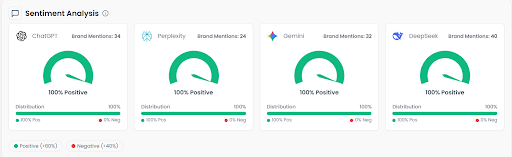
By identifying whether coverage is positive, neutral, or negative, Tesseract gives a clearer view of brand reputation across the AI platform.
Semrush AI Visibility and PR Toolkit
The Semrush AI Visibility and PR Toolkit is ideal for SEOs and digital PR teams who want to track brand visibility across AI-driven search engines while earning authoritative mentions. The AI visibility features provide a benchmark score comparing your brand to competitors, along with metrics such as AI Share of Voice and trend graphs to monitor presence over time.
The brand performance dashboard includes sentiment analysis that shows how AI models describe your brand and highlights topics where competitors dominate. On the PR side, the toolkit identifies the outlets most frequently cited by AI engines, highlighting which sources are trusted seed sources that influence AI search visibility. This unified workflow measures visibility while strengthening the brand authority needed for LLM inclusion.
HubSpot AI Engine Optimization Grader
HubSpot’s AI Engine Optimization Grader (formerly AI Search Grader) is designed for teams who want optimization integrated into their CMS. These tools scan your website, surface opportunities, and rank them by priority.
The Grader identifies the gap between your traditional SEO performance and your AI visibility. For example, a client’s website may rank well in standard search but appear rarely in AI-generated answers. HubSpot identifies these visibility gaps and informs strategies to improve E-E-A-T (Experience, Expertise, Authoritativeness, and Trustworthiness) in ways that are recognized by language models.
Surfer SEO
Surfer SEO focuses on optimizing content drafts using insights from top-ranking and AI-cited pages. It provides real-time content scoring for keyword density, structural markers, and information depth.
In 2026, it includes a Cite-ability Score that tells you how likely a section is to be quoted by an AI agent. It is particularly useful for content teams publishing at scale who need to maintain high quality and search engine performance.
AlsoAsked
AlsoAsked caters to bloggers and specialists seeking to uncover People Also Ask queries and build topic clusters. It extracts questions from Google’s PAA boxes and presents them as branching visual maps.
This makes it easier to create comprehensive content briefs that mirror the query fan-out process used by AI chatbots when they expand on a user’s initial prompt.
WriterZen
It is an AI-powered content marketing ecosystem designed to simplify the SEO lifecycle from research to draft. It specializes in Topic Discovery and Keyword Clustering, using its proprietary “Golden Filter” (KGR) to pinpoint low-competition, high-opportunity search terms. By integrating Google’s Natural Language Processing (NLP), it provides real-time semantic suggestions to ensure content matches modern search intent.
The 2026 version features an advanced AI Assistant for generating structured, data-backed outlines and a built-in plagiarism checker, making it an all-in-one solution for strategists focusing on topical authority.
Screaming Frog SEO Spider
This is the industry-standard desktop crawler for technical SEO auditing. It mimics search engine bots to identify broken links, audit redirects, and analyze site architecture at scale. In 2026, it has evolved beyond basic crawling with direct AI API Integrations (OpenAI, Gemini, and Ollama).
Users can now run custom AI prompts during a crawl to automate bulk tasks like generating meta tags, classifying page intent, or performing sentiment analysis. It remains essential for GEO to ensure that site structures are transparent and easily retrievable by AI-powered search engines.
SparkToro
SparkToro is perfect for understanding where your target audience spends time outside of search. Its AI conversational search lets you describe audiences naturally and returns data on podcasts, social channels, and niche sites.
Since AI models increasingly rely on community signals from platforms like Reddit and niche forums for authority, SparkToro helps you build the off-page presence that triggers AI mentions.
Criteria for Choosing the Best AI SEO Tools
When evaluating your 2026 tech stack, consider these four pillars:
- GEO and AEO Support: Does the tool track visibility inside ChatGPT and Perplexity, or just Google?
- Sentiment Tracking: Can the tool tell you if AI models perceive your brand positively or negatively?
- Integration: Does it work seamlessly with your existing CMS and analytics tools?
- Predictive Power: Does it provide proactive suggestions for upcoming search trends?
AI SEO Tools: Plans and Pricing Comparison
| Tool | Plans and Pricing |
| Tesseract | Free: $0 (1 user, 3 competitors, 5 prompts, 5 keywords)
Basic: $249/mo (1 user, 3 competitors, 100 prompts, 100 keywords) Pro: $399/mo (3 users, 4 competitors, 200 prompts, 200 keywords) Enterprise: Custom (5 users, 6 competitors, custom prompts and keywords) |
| Semrush One | Pro: $117.33/mo (billed annually)
Guru: $208.33/mo (billed annually) Business: $416.66/mo (billed annually) |
| Surfer SEO | Standard: $99/mo
Pro: $182/mo |
| WriterZen | Keyword Research: $75 one-time
All-In-One Basic: $150 one-time All-In-One Advanced: $225 one-time |
| Screaming Frog SEO Spider | Free: $0 (500 URLs)
Paid: £199/year (unlimited URLs) |
Stay Visible Across Search Platforms
AI SEO tools are essential in 2026 for improving visibility, boosting rankings, and staying competitive in AI-driven search environments. AdLift helps businesses optimize content, monitor AI search presence, and automate repetitive tasks. The most effective SEO strategy combines AI insights with human oversight.
AI provides actionable data, trend predictions, and content optimization suggestions while humans ensure the content aligns with brand voice, meets user expectations, and maintains quality standards. Investing in AI-based SEO tools is no longer optional. It is crucial for brands that want to grow, maintain authority, and stay visible across both traditional and AI-powered search platforms.