
Why Does Gemini Choose Some Websites but Ignores Others?
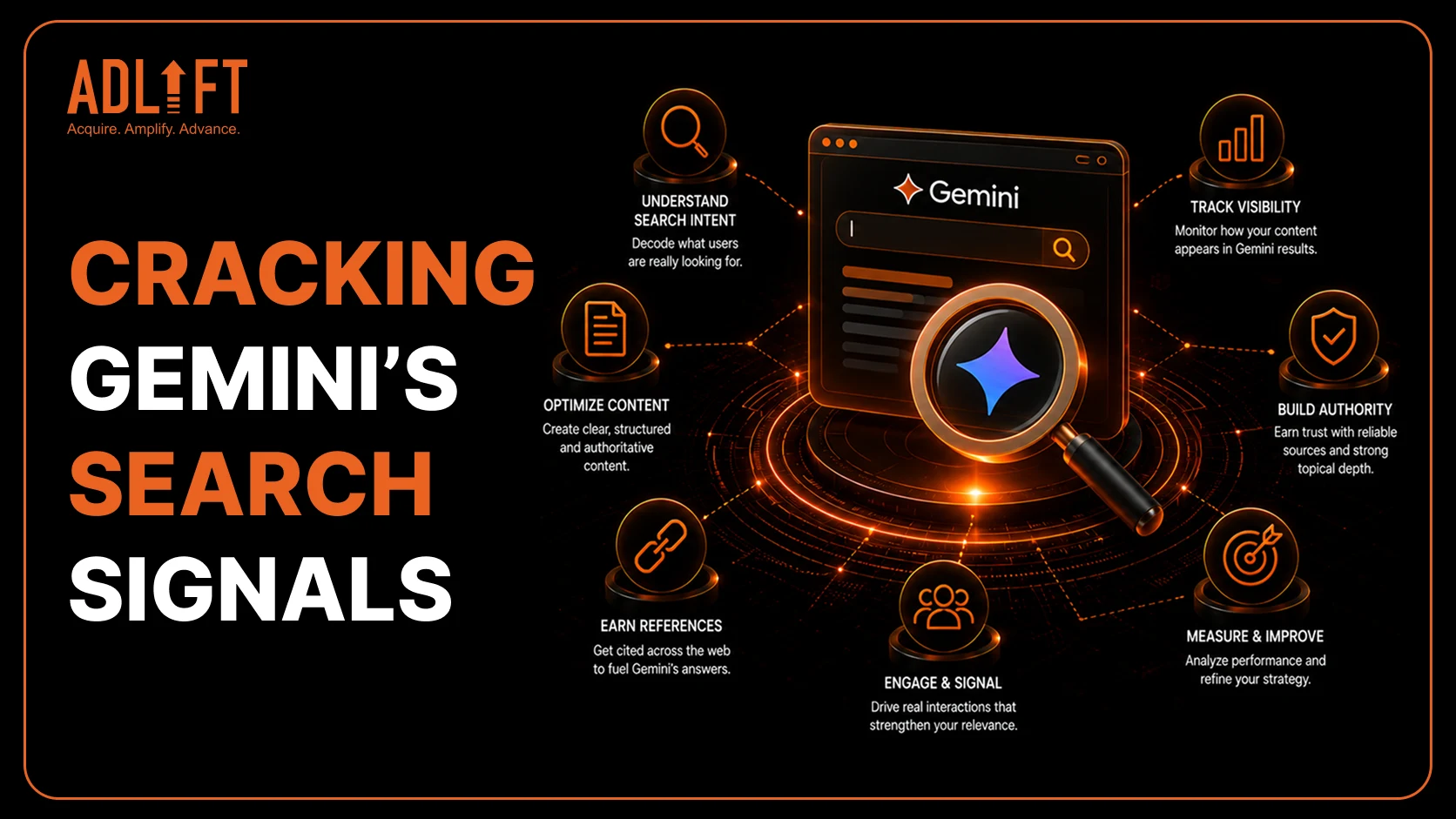
You spend hours perfecting a page, hit publish, and watch it rank for your most valuable keyword. Then Gemini’s AI Overview shows up, summarizes the exact topic you own, links out to three other sites, and skips you entirely. That silent organic drop is happening to brands every single day, often without them even noticing.
Recent industry data from HubSpot shows that 80% of consumers now rely on AI-written summaries for at least 40% of their searches, and that number keeps climbing fast. This shift is fundamentally changing how people discover information online, and brands left out of these AI answers are losing visibility fast.
Understanding how Gemini works is the first step to fixing that. So if you are ready to stop getting bypassed, keep reading.
How Does Gemini Actually Decide Which Websites to Trust?
Let’s pivot from the problem to the science and break down what’s actually happening under the hood, minus the jargon that usually makes this stuff confusing.
Real-time Retrieval-Augmented Generation (RAG) Loop
Gemini doesn’t lean on static training data alone. When someone asks a question, it fires off a live Google search, pulls data from the top-ranking candidate pages, and stitches the pieces into one coherent answer.
That’s the short version of how Gemini works behind the scenes. If your page lacks strong technical indexing, the AI simply can’t fetch it, which means it can’t cite it either.
“Query Fan-Out” Method
Gemini splits one complex user prompt into dozens of miniature sub-questions to gather a complete pool of answers. Think of it as the model interviewing the internet from every possible angle instead of asking a single blunt question.
If your pages don’t explicitly answer these logical sub-questions in structured headings, you miss the citation cut entirely. This is where most sites lose the race without even realizing it.
Google’s Knowledge Graph & Entity Authority
Before Gemini cites anything, it cross-checks the claim against Google’s global index of recognized entities, meaning verified brands, people, and objects with an established track record.
An unverified site sharing opinions gets passed over in favor of an established entity backing its claims with hard, original data. Authority isn’t optional anymore; it’s the entry ticket. Building that trust takes consistent, factual, well-sourced content over time.
What are AEO and GEO, and Why are They Killing Traditional SEO?
Now that you understand the AI’s thought process, it’s time to meet the two marketing disciplines built specifically to master it.
Answer Engine Optimization (AEO)
AEO is about designing content specifically to become the single, authoritative, direct answer to natural language voice and chat prompts. It’s less about ranking and more about being chosen outright.
The focus here is winning the “zero-click” battle, where users get their answer without ever visiting a website. That means your content has to do the convincing in seconds.
Generative Engine Optimization (GEO)
GEO focuses on formatting and structuring your website elements, so generative models like Gemini, Claude, and ChatGPT can effortlessly summarize and reference you.
Once you understand how Gemini citation works, GEO becomes less mysterious and far more actionable. The goal is earning maximum citation share of voice over your competitors. It’s a long game, but it compounds fast once the structure is right.
Why is Your Website Currently Being “Ghosted” by the Algorithm?
This is the hard truth phase, where we connect AEO and GEO directly to the mistakes quietly costing you visibility right now.
“Me-Too” Commodity Content Trap
Regurgitating the same definitions and lists as the top ten search results is a losing move. Gemini has already read those exact points a hundred times over; it doesn’t need to read yours too.
The fix is injecting proprietary data, fresh case studies, and unique brand angles nobody else has. Original insight is the only real currency left in this game.
Information Buried in “Non-Extractable” Walls of Text
Keeping your best answers trapped inside dense, conversational, long-winded paragraphs is a quiet killer.
The data is incredibly clear on this: large language models are between 28% and 40% more likely to cite content with a clear, skimmable structure, think headings, bullet points, and tables, over standard narrative prose. This is exactly why FAQs, listicles, and structured how-to guides dominate AI sources. Deliver the answer upfront, then explain.
Failing the Extreme Freshness Bias
Leaving your best content to gather digital dust is another silent visibility killer. AI platforms heavily favor real-time relevancy, so stale statistics and outdated dates work against you constantly.
The fix is simple: keep updating your numbers, dates, and “last modified” tags on a regular schedule. Freshness signals tell Gemini your page is worth trusting right now, not last year.
How Can AdLift Help You Dominate the AEO and GEO Landscape?
Let’s move from educational panic to an actual, professional plan for closing this gap for good.
Transitioning your organic footprint from old school SEO to AEO and GEO takes a specialized setup most teams don’t have in-house. This is exactly where AdLift steps in, with teams who live and breathe this work daily.
We combine technical structuring with content strategy built specifically for AI extraction. The result is a site that answers before your competitors even finish loading.
Data-driven Content Built for AI Integration
At AdLift, we don’t just write blogs; we engineer structured data. Our full-stack content and technical teams reshape your brand’s digital footprint so Gemini, ChatGPT, and Perplexity confidently pull from and link back to your web pages.
Every piece is built around how Gemini chose citations in the first place, not guesswork. That precision is what separates cited brands from ignored ones.
Real-time Citation Tracking with Tesseract
How do you actually measure SEO success in an AI-driven world? You use Tesseract, AdLift’s proprietary, state-of-the-art AI search visibility tool built for exactly this.
Instead of guessing if your optimizations are working, Tesseract monitors exactly when, where, and how often your brand gets cited across Google AI Overviews, Gemini, ChatGPT, and Perplexity. It tracks your true brand share of voice, flags content gaps, and alerts you the moment a competitor steals your recommended spot.
Are You Ready to Stop Chasing Links and Start Owning the Answer?
The internet is shifting from a database of blue links to a matrix of syntheses, and there’s no slowing that down. Brands that optimize for GEO and AEO today will capture the bulk of generative search traffic tomorrow, while the rest fade into irrelevance.
Gemini’s algorithm crawls the web constantly, and every day you wait is another day a competitor anchors itself as its favorite citation.
Stop guessing and start acting. Let our team run your domain through Tesseract to show you exactly where you stand, why competitors are getting recommended over you, and precisely how to fix it.
Source:
https://blog.hubspot.com/marketing/generative-engine-optimization-statistics
