ChatGPT SEO: Strategies to Improve AI Search Rankings
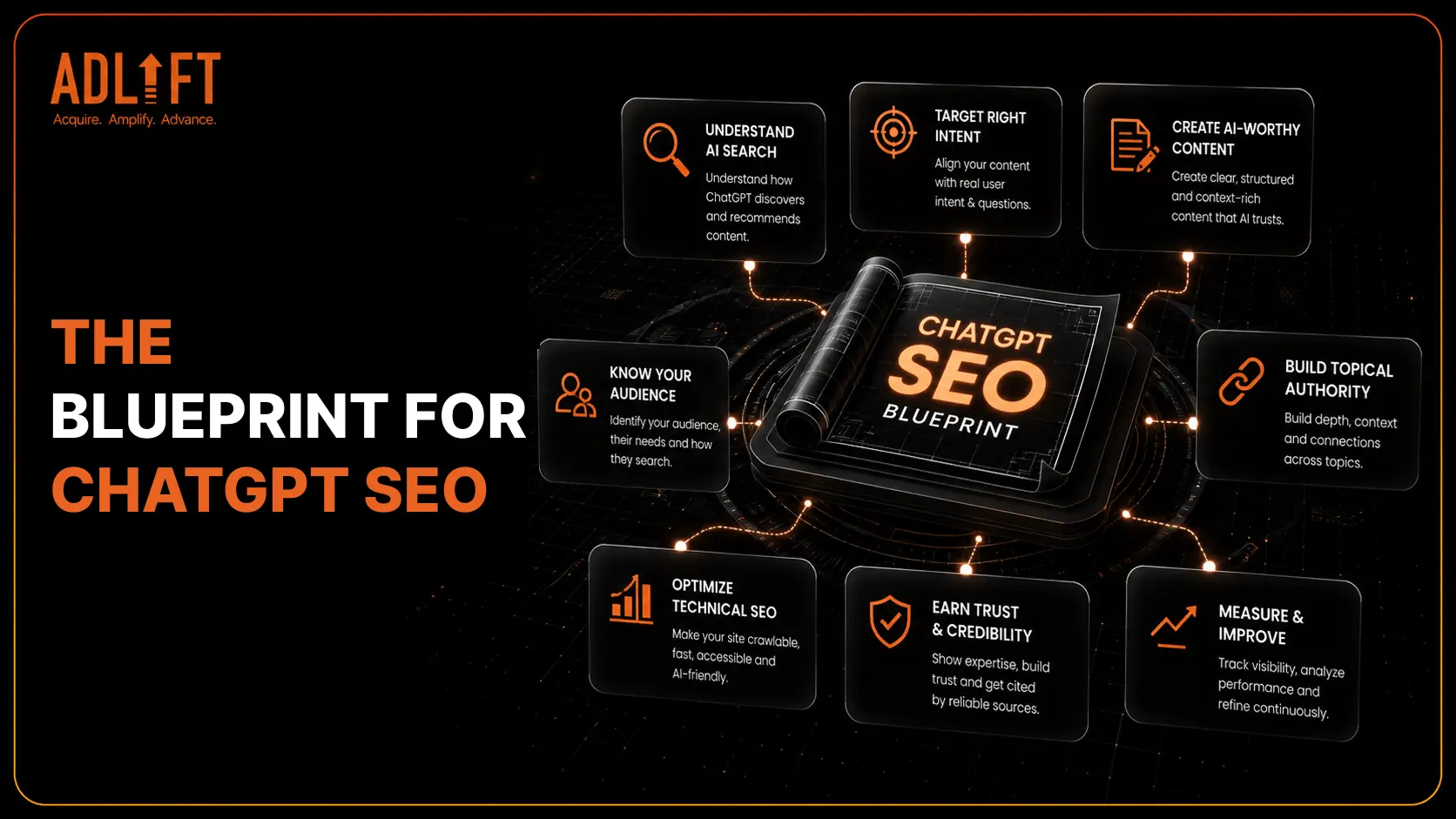
Search is no longer limited to blue links and rankings. With the rise of ChatGPT Search and other AI-powered answer engines, users increasingly receive complete, conversational responses instead of browsing multiple websites. This shift has redefined content optimization, making it essential for brands to create information that AI systems can retrieve, interpret, and confidently cite.
AI search prioritizes authoritative, well-structured, and context-rich content at the passage level. A successful ChatGPT SEO strategy focuses on improving extractability, strengthening entity credibility, and aligning content with retrieval-augmented generation (RAG) models.
This blog explains how implementing effective SEO for ChatGPT, businesses can increase their chances of earning AI citations, appearing in generated responses, and capturing high-intent traffic.
Passage-level Content Architecture for AI Search Retrieval
You cannot secure citations inside ChatGPT Search until your pages pass the platform’s initial content-extraction checks. Structuring your technical and editorial layouts determines whether your insights are cited directly or passed over for competitor sources.
Deploying comprehensive ChatGPT SEO Optimization from the architectural level guarantees that crawlers such as OAI-SearchBot can parse and digest your key claims instantly.
Step 1: Implement the BLUF (Bottom Line Up Front) Answer Model
To capture immediate citation real estate, you must place direct, 40-to-80-word summary answers in the first 8 to 12 lines directly beneath every major section header. Large Language Models chunk and weigh passage text heavily at heading boundaries.
By delivering an immediate, high-density synthesis right at the top of a section, you provide retrieval-augmented generation (RAG) systems with an instant, citable summary that can be extracted verbatim without needing to piece together context from multiple paragraphs.
Step 2: Establish an Explicit JSON-LD Schema Architecture
Technical accessibility starts with deploying comprehensive, accurate schema markup, including FAQPage, Article, Organization, and Author schemas, across all key landing pages and insights. Delivering clean, machine-readable metadata allows AI search crawlers to parse entities, author credentials, and core facts without burning extra compute budget parsing client-side JavaScript.
This structured source of truth accelerates entity resolution, significantly boosting your domain’s credibility scores during real-time retrieval routines.
Step 3: Optimize for Conversational Long-Tail Query Patterns
Effective editorial structuring requires shifting your primary target phrasing from static short-tail keywords to natural-language, question-based prompts such as “How do I…” or “What is the difference between…”. Aligning heading structures directly with actual user prompt syntax dramatically increases semantic similarity scores during vector database retrieval sweeps.
Success in ranking on ChatGPT comes from matching this semantic footprint, allowing vector search systems to map user queries directly to semantically relevant content.
Measuring AI Search Visibility and Generative Citation Metrics
Monitoring AI search success requires tracking both how effectively your content earns citations in AI answers and the quality of the referral traffic those citations deliver. Traditional rank trackers that monitor blue-link positions cannot capture conversational share of voice.
Retrieval Efficiency Tracker (Front-End Citation Signals)
Evaluating your front-end visibility starts with monitoring passage extraction rate, which measures how frequently LLMs select specific paragraph chunks from your site to answer target topic queries.
Beyond mere extraction, you must evaluate citation placement prominence to determine whether your brand attribution appears as a primary inline link or a secondary footnote, as top placement directly dictates click-through performance.
Equally critical is entity co-occurrence density, which measures how consistently AI models pair your brand name with primary industry keywords and specialized solution categories. Finally, maintaining a strong content freshness velocity ensures your page updates index rapidly, signaling to real-time AI scrapers that your data remains current and reliable.
Tesseract by AdLift helps monitor these retrieval and citation signals at scale, enabling teams to identify optimisation opportunities before they impact discoverability.
Referral Value Dashboard (Back-End Traffic Signals)
Measuring real business impact requires tracking chatgpt.com referral volume to analyze the flow of qualified sessions originating from outbound links inside ChatGPT responses. As users who click AI citations have already ingested a synthesized answer, they demonstrate high intent, which reflects directly in your assisted conversion velocity for lead forms and key assets.
To ensure your brand authority scales, track brand mention frequency across third-party publications to see how off-page citations feed AI knowledge graphs. Concurrently, monitor your deep-page entry ratio.
A high percentage of AI-referred visitors landing directly on specialized tactical subpages proves that conversational search engines are routing prospective buyers directly to your specific solutions rather than generic entry points. Tesseract can consolidate these citation, referral, and engagement metrics into a unified dashboard, making it easier to measure AI search performance alongside traditional SEO KPIs.
Critical Technical and Editorial Errors That Destroy AI Search Reach
Relying on traditional SEO strategies like keyword stuffing or deep introductory fluff creates immediate friction with AI crawlers. Avoid structural patterns that cause RAG models to skip your content. Executing SEO for ChatGPT effectively requires abandoning these outdated habits to secure consistent citation market share.
Hiding Key Answers Behind Heavy Client-Side Scripts
Rendering core answers, tables, or FAQs exclusively through interactive client-side JavaScript accordions or tabbed elements creates a major technical bottleneck. AI search scrapers prioritize speed and computational efficiency, meaning they frequently bypass script-heavy content in favor of fast, plain-text HTML.
If your core insights rely on client-side execution to render, crawlers may parse an empty container, resulting in zero citations despite high traditional search rankings.
Writing Vague, Fluff-Heavy Introductory Paragraphs
Opening sections with long-winded, multi-paragraph setup copy before delivering actual tactical answers dilutes your content’s semantic value. Generative models split web pages into smaller text chunks (typically 120–200 words) before running vector comparisons.
When a chunk consists primarily of introductory filler or generic background context, its semantic relevance score drops significantly, causing the retrieval engine to discard your page in favor of dense, answer-first competitor passages.
Publishing Generic, Unverified AI Rewrites
Churning out generic articles that summarize existing web content without introducing original research, fresh stats, or first-hand experience severely limits your reach. Generative AI systems prioritize “information gain” and are designed to filter out redundant summaries.
If your content lacks unique metrics, named brand methodologies, or original data, models flag it as repetitive consensus noise and omit it entirely from generated answers.
Converting ChatGPT Search Citations into High-intent Revenue
Generative Engine Optimization (GEO) is not about accumulating vanity page views; it is a strategic approach to becoming the primary trusted authority referenced during active buyer research. Executing a rigorous ChatGPT SEO Optimization blueprint ensures that when AI search engines summarize your category, your brand is framed as the premier solution.
Format Data Using Bite-sized HTML Tables and Lists
Convert complex feature comparisons, benchmark metrics, and step-by-step processes into clean HTML tables and numbered lists. Structured formats allow language models to isolate variables without spending tokens interpreting dense narrative text.
Ensure every table row and column header uses explicit entity labels, such as “Customer Retention Rate (%)” instead of ambiguous terms like “Value”, to prevent semantic misinterpretation.
Clean HTML tables are frequently extracted and displayed directly inside generative answer layouts, giving your brand immediate visual dominance.
Build Proprietary Data Assets and Branded Terminology
Publish original surveys, industry benchmark reports, case studies, and proprietary framework definitions. Unique data creates an irreplaceable information gain signal that forces LLMs to reference your exact URL when answering statistical queries.
Furthermore, assigning distinct, branded terms to your specialized frameworks forces language models to credit your organization whenever explaining those concepts, establishing your brand as the primary authority for the topic across knowledge bases.
Strengthen Multi-platform Digital PR and Brand Mentions
Secure active mentions, reviews, and citations across authoritative third-party news sites, industry publications, and podcast summaries. Generative models cross-verify claims across independent sources before confirming a domain’s authority.
Maintaining consistent brand entity information across external directories, Wikidata entries, and official channels eliminates discrepancies, reinforcing model confidence and ensuring your domain is selected as a primary source during real-time RAG routines.
Future-proof Your Brand With ChatGPT SEO
As AI-powered search becomes the preferred way people discover information, brands must optimize for citations, not just rankings. A successful ChatGPT SEO strategy combines passage-level content, structured data, original insights, and strong entity authority to help AI models retrieve and reference your content with confidence.
By prioritizing technical accessibility, conversational relevance, and information gain, businesses can improve visibility across generative search platforms. Investing in SEO for ChatGPT today positions your brand to earn trusted AI citations, attract high-intent referral traffic, and build a lasting competitive advantage as AI search continues to evolve.
Sources:
https://developers.openai.com/api/docs/bots
https://help.openai.com/articles/9237897-chatgpt-search
https://arxiv.org/abs/2311.09735
https://arxiv.org/abs/2005.11401
https://schema.org/
https://developers.google.com/search/docs/appearance/structured-data/intro-structured-data
https://platform.openai.com/docs/guides/embeddings
https://en.wikipedia.org/wiki/BLUF_(communication)
https://help.openai.com/en/articles/20001243-advertiser-guidance-for-allowing-openai-web-crawlers
https://developers.google.com/search/docs/crawling-indexing/javascript/javascript-seo-basics