Beyond the Query: How Agentic AI Manages 1,000 Complex Tasks From a Single Command
The agentic AI market was valued at USD 6.96 billion in 2025 and is projected to grow from USD 9.89 billion in 2026 to USD 57.42 billion by 2031, at a growth rate of 42.14%. This rapid growth reflects a fundamental shift in how enterprises are beginning to operate with agentic AI systems.
Imagine typing a single instruction like “Audit our last quarter’s supply chain delays and issue vendor updates,” and watching hundreds of coordinated actions unfold automatically across databases, emails, analytics platforms, and enterprise applications. No task lists. No manual coordination. No waiting for teams to pass information between systems. As organizations explore new ways to manage rising operational complexity, many leaders are now asking what agentic AI is and how it differs from traditional automation tools.
Let’s understand how one high-level command can expand into 1,000 coordinated actions and why this technology is reshaping enterprise operations.
Why is Traditional Software Automation Failing the Modern Enterprise?
For years, automation has been viewed as the answer to repetitive and time-consuming work. While it delivers efficiency gains, many enterprise processes involve changing conditions, fragmented data sources, and unexpected obstacles that cannot be predicted in advance.
Rule-based Bots (RPA)
Rule-based Bots, commonly known as Robotic Process Automation (RPA), are designed to follow predefined instructions. They excel at repetitive tasks where every step remains consistent and predictable.
However, these bots struggle when conditions change. If a website layout is updated, a database column is renamed, or a required field moves location, the bot typically fails and stops executing tasks.
Generative AI Models
Generative Artificial Intelligence (AI) models are highly capable when it comes to reading, summarizing, and creating text. They can answer questions, generate reports, and process large volumes of information quickly.
Despite these strengths, they cannot directly interact with enterprise applications, modify records, update Customer Relationship Management (CRM) platforms, or execute software operations without additional systems supporting them.
Agentic AI Ecosystems
The agentic AI meaning goes far beyond generating content or responding to prompts. These ecosystems actively interact with software environments and make context-aware decisions while pursuing a goal.
Instead of stopping when an issue appears, agents analyze feedback, identify alternative paths, correct errors, and continue working toward the intended outcome. This makes them significantly more adaptable than traditional automation systems.
How Does a Single Prompt Turn Into 1,000 Coordinated Actions?
With nearly 79% of companies already using AI agents in core operations, the latest agentic AI statistics show more than adoption; they reflect the speed at which enterprise intelligence is evolving.
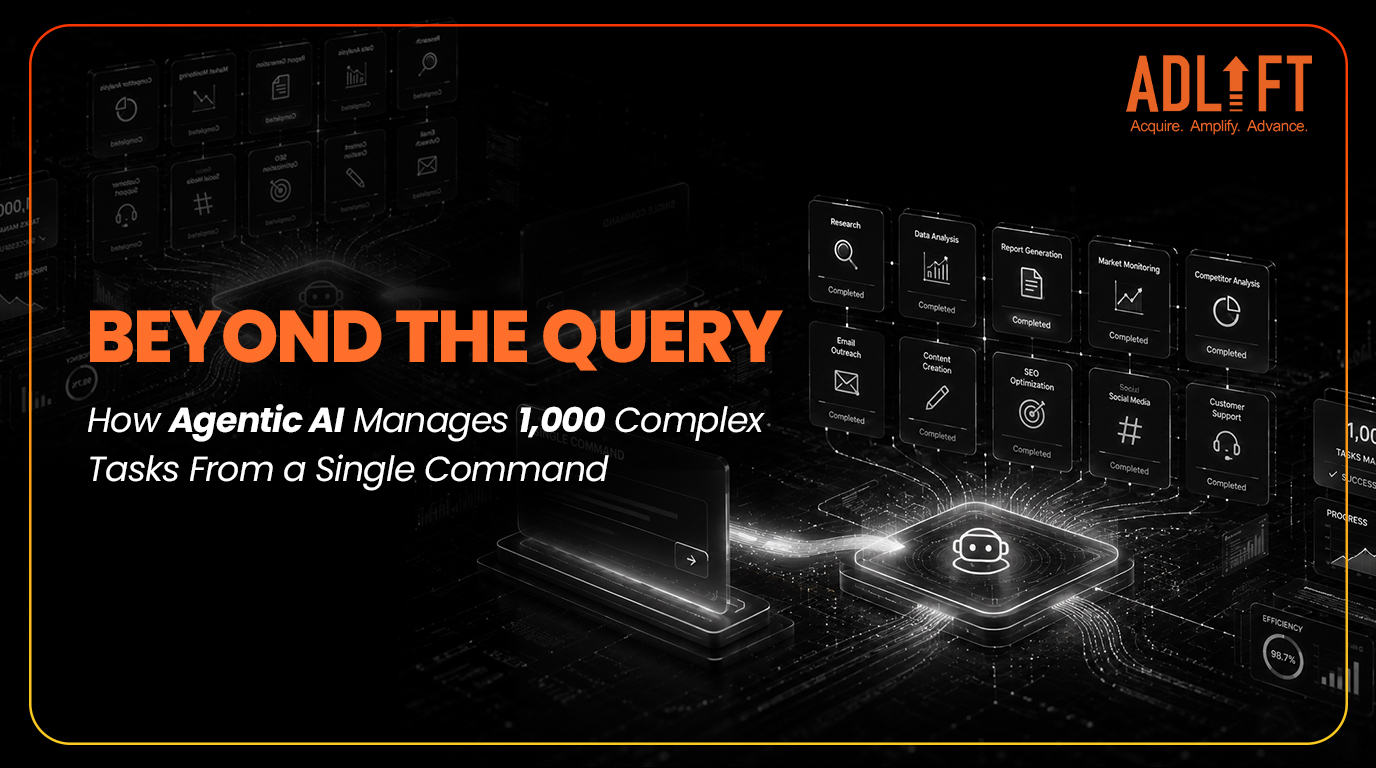
A simple executive instruction like “Audit last quarter’s supply chain delays and issue vendor updates” hides multiple layers of work beneath it. In agentic systems, that single prompt is decomposed into a structured execution plan, where autonomous agents coordinate across tools, data sources, and workflows like a distributed project team.
Goal Decomposition and Planning
The master model begins by understanding the command and identifying all required outcomes. It breaks the objective into a dynamic sequence of approximately 50 discrete sub-objectives that collectively contribute to the final result.
These objectives may include gathering shipment records, analyzing delivery delays, reviewing vendor communications, identifying recurring issues, generating reports, and preparing outbound updates for suppliers.
Tool Discovery and Selection
Once the plan is established, the system identifies where relevant information exists. It scans available enterprise connections through secure Application Programming Interfaces (APIs) and determines which systems contain the required data.
The agent may simultaneously access databases, document repositories, communication platforms, analytics systems, and enterprise resource planning tools to collect information efficiently.
Multi-agent Delegation
After locating the necessary resources, specialized worker agents are assigned specific responsibilities. One agent may query Structured Query Language (SQL) databases, another may review unstructured customer emails, while another prepares outbound records for enterprise systems.
This parallel execution model allows multiple tasks to run simultaneously, dramatically reducing the time required to complete large-scale operational objectives.
Continuous Multi-turn Reasoning
Execution does not stop once tasks are assigned. Agents continuously evaluate progress, monitor outputs, and review errors throughout the workflow.
When issues arise, the system examines error messages, modifies queries, retries operations, and validates outcomes before proceeding. This ongoing reasoning process allows agents to adapt without requiring constant human oversight.
What Core Technology Powers Multi-task Agentic Execution?
Managing thousands of coordinated actions requires more than a powerful language model. Enterprise-grade autonomy depends on structured communication frameworks, intelligent reasoning loops, memory systems, and secure execution environments. These technologies provide the foundation required for agents to collaborate effectively while maintaining consistency across large and complex operations.
The ReAct Framework
The Reason and Act (ReAct) framework enables agents to continuously alternate between analyzing information and taking action.
Every action generates new information, which influences the next decision. This creates a dynamic execution cycle that allows agents to respond intelligently to changing circumstances.
Model Context Protocol (MCP)
Model Context Protocol (MCP) serves as a standardized framework that helps agents discover, access, and utilize enterprise data efficiently.
Rather than creating custom integrations for every application, MCP provides a structured method for connecting agents to reusable organizational knowledge and data sources.
Agent-to-Agent (A2A) Routing
Agent-to-Agent (A2A) routing enables specialized agents to communicate directly with one another.
Instead of routing every request through a central coordinator, agents can hand off tasks to the most suitable worker. This decentralized communication model improves efficiency and reduces bottlenecks.
Autonomous Sandboxes
Autonomous sandboxes are isolated software environments where agents can safely write, test, and modify Python code.
These environments allow file transformations, data processing, and temporary code execution without affecting production systems. Organizations exploring how to use agentic AI often begin with autonomous sandboxes before expanding agent capabilities across broader operational functions.
How do You Retain Total Operational Control Over Autonomous Workflows?
A common concern surrounding autonomous systems involves governance and accountability. Giving software the ability to make decisions does not mean removing oversight from business-critical operations. Successful deployments depend on clearly defined guardrails that control permissions, monitor actions, and ensure human involvement when necessary.
Human-in-the-Loop (HITL)
Human-in-the-Loop (HITL) frameworks introduce approval checkpoints for sensitive activities.
Tasks involving financial transactions, external communications, legal obligations, or strategic decisions can require explicit human authorization before execution continues.
Read-only Data Frameworks
Many organizations implement read-only access controls for critical systems. These restrictions allow agents to analyze information without modifying databases, deleting records, or making changes that could impact production environments.
Central Control Towers
Central control towers provide real-time visibility into every action performed by autonomous systems.
Operations teams can monitor API activity, review decision paths, track costs, and understand how agents are progressing toward their assigned objectives.
Data Lineage Auditing
Data lineage auditing creates a complete historical record of every action performed during execution.
Organizations can track documents reviewed, web resources accessed, data sources consulted, and decisions made. Among the most valuable benefits of agentic AI is the ability to maintain transparency and accountability while managing highly complex workflows.
Turn Enterprise Complexity Into Productivity With Agentic AI
Enterprise automation is entering a new phase where software can move beyond executing instructions and begin pursuing objectives independently. Agentic systems combine planning, reasoning, tool usage, and collaboration to transform a single business command into hundreds or even thousands of coordinated actions. Their ability to analyze failures, adjust strategies, and continue progressing creates opportunities that traditional automation struggles to achieve.
Organizations aiming to improve efficiency, reduce manual workloads, and connect fragmented systems should begin evaluating agent-driven architectures now.
By implementing secure governance frameworks and controlled autonomous workflows, businesses can unlock greater scalability, faster execution, and smarter operational outcomes across the enterprise.
Source:
https://www.mordorintelligence.com/industry-reports/agentic-ai-market
https://www.accelirate.com/agentic-ai-statistics-2026/