Claude AI for SEO: 5 Use Cases Beyond Simple Writing Tasks
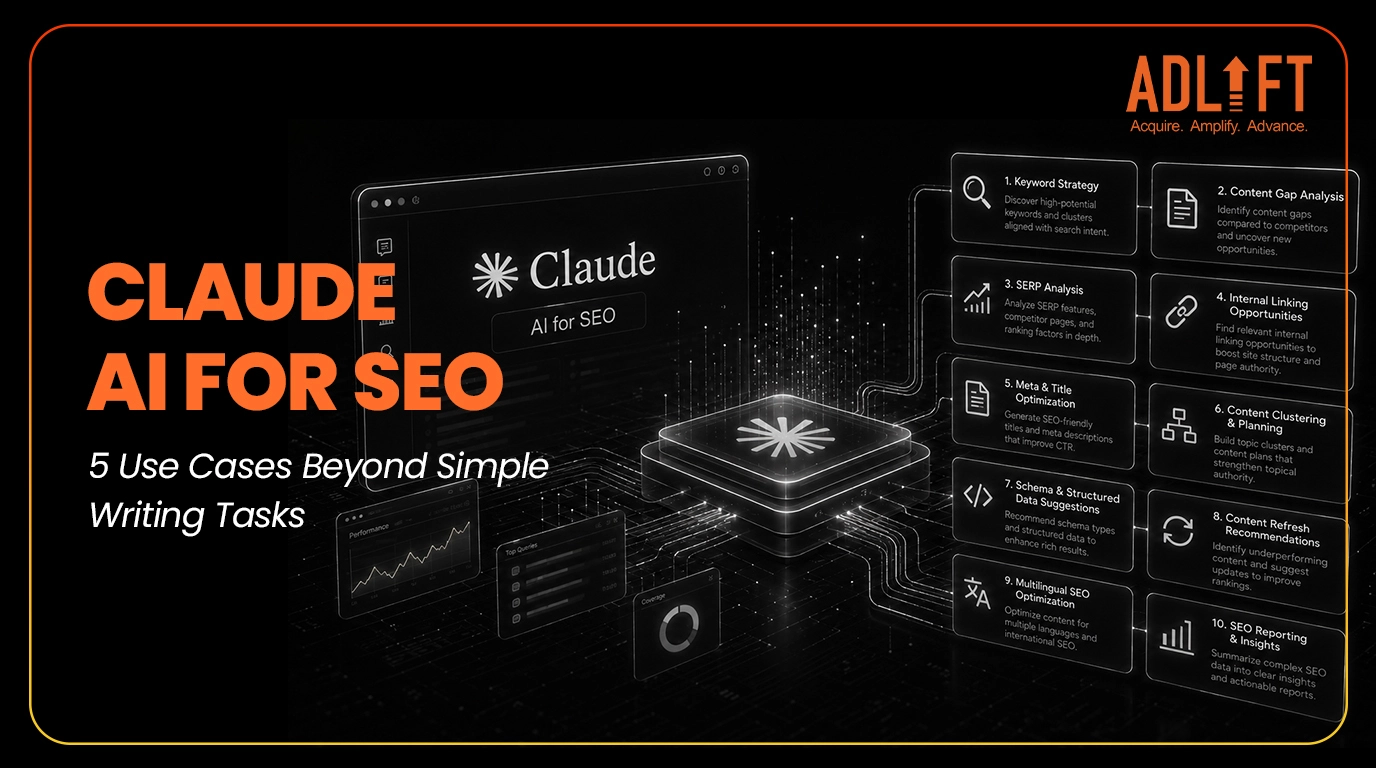
Most SEO professionals still treat AI as a content-drafting tool, missing its bigger opportunities. As sites and SEO datasets grow more complex, manual analysis increasingly slows decisions and limits efficiency.
This mirrors a broader trend: AI adoption among US firms more than doubled in two years. From 3.7% to 9.7% by August 2025 (Census Bureau, via Anthropic’s Economic Index), with adoption highest in information-heavy sectors like SEO. That’s part of why Claude AI for SEO is gaining traction with enterprise teams.
Let’s explore how to use Claude AI for SEO through five advanced use cases that can help strengthen your SEO strategy and improve operational efficiency.
Why is Claude Natively Tailored for Heavy SEO Data Operations?
SEO teams often work with extensive datasets that include keyword exports, crawl reports, backlink profiles, log files, and Search Console data. Analyzing these datasets manually can be time-consuming and prone to oversight. This is where Claude AI for SEO stands out. Claude is structurally designed to absorb large volumes of information while maintaining context throughout the workflow, making it well-suited for complex SEO operations.
The following capabilities illustrate how Claude supports advanced SEO tasks involving large-scale data processing, analysis, and automation:
| Claude Capability | SEO Application |
| 1-Million-Token Context Window | Processes full site audits, competitor link profiles, and years of Search Console data within a single prompt |
| Extended Thinking | Structures complex analytical workflows and technical evaluations |
| Sandboxed Artifacts | Creates interactive dashboards and visual reports |
| Code Execution Engine | Runs Python-based data processing and automation tasks |
| Large Dataset Processing | Handles extensive keyword, crawl, and link data efficiently |
5 Advanced Claude AI Use Cases for SEO Beyond Content Writing
Here are five advanced use cases that demonstrate how Claude AI for SEO can streamline analysis, improve efficiency, and support more data-driven SEO decision-making.
Processing High-volume Keyword Intent Clustering
Keyword research often generates thousands of search terms that need to be organized before content planning can begin. Traditional clustering methods typically group keywords based on similar words or phrases, which can miss the actual intent behind a search query.
With Claude AI for SEO, users can upload large keyword exports from third-party SEO tools and instruct Claude to group terms according to semantic intent. The model can categorize keywords into informational, commercial, navigational, and transactional groups, creating a clearer framework for content planning.
The Process
- Upload a raw keyword CSV file.
- Provide instructions to classify keywords by search intent.
- Request a structured output grouped into logical clusters.
- Export the organized data for content mapping.
The Advantage
By analyzing search intent rather than simple keyword similarities, Claude helps reduce keyword cannibalization and supports more strategic content planning. The value of this kind of granular categorization isn’t unique to SEO either.
Anthropic tracks more than 3,000 distinct work tasks across Claude.ai, and even the ten most common ones account for less than a quarter of total usage. Intent clustering works the same way, surfacing dozens of meaningful sub-groups that a simple keyword-similarity pass would otherwise flatten into one.
Parsing Server Log Files for Googlebot Crawl Errors
Server log analysis is one of the most valuable technical SEO activities, but the volume of data involved can make manual reviews challenging and time-consuming.
Using Claude AI for SEO, SEO professionals can upload raw server logs and instruct Claude to isolate requests associated with Googlebot user agents. The model can then evaluate crawl behavior and identify patterns that may affect website indexation and crawl efficiency.
The Process
- Upload or paste raw server logs.
- Filter requests originating from Googlebot.
- Identify crawl paths and recurring patterns.
- Highlight anomalies and crawl inefficiencies.
The Advantage
Claude can quickly identify redirect chains, unnecessary crawl paths, dead URLs, and other issues that consume crawl budget. These insights help technical teams prioritize fixes that improve crawl efficiency and search engine accessibility, without requiring someone to manually scroll through gigabytes of raw log entries.
Mapping Semantic Gaps Against Top-ranking Competitors
Ranking improvements often depend on comprehensive topic coverage rather than simply increasing keyword usage. Analyzing competitor content can help identify informational gaps that may be limiting a page’s visibility in search results.
With Claude AI for SEO, users can compare their content against top-ranking competitor pages to identify missing topics, entities, schema opportunities, and supporting information.
The Process
- Provide your page’s content or HTML structure.
- Upload content from top-ranking competitor pages.
- Request a comparison of entities, schema, subheadings, and topic coverage.
- Review the identified optimization opportunities.
The Advantage
Rather than focusing on additional keyword placement, Claude highlights content gaps that can improve topical relevance and strengthen authority. This kind of comparison is inherently iterative: you review a first pass, ask Claude to dig deeper on a specific entity or competitor, and refine from there. That collaborative pattern, often called augmentation, is now the single most common way people interact with Claude on Claude.ai, edging out fully automated, one-shot requests. Gap analysis is a natural fit for that back-and-forth.
Auditing High-volume Internal Link Frameworks
Internal links help distribute authority across a website and guide search engines towards important content. However, evaluating thousands of internal links manually can be difficult, particularly for large websites.
Using Claude AI for SEO, SEO professionals can analyze crawl exports and internal link reports to assess how authority flows across a site.
The Process
- Upload crawl data or internal linking exports.
- Request an analysis of link equity distribution.
- Review page depth and navigation structures.
- Identify structural weaknesses and linking opportunities.
The Advantage
Claude can identify orphan pages, highlight important content buried deep within the site architecture, and surface pages receiving insufficient internal authority. It can also recommend improvements to content silos and internal linking structures.
This matters more as sites scale. Enterprise workloads processed through Claude’s API vary enormously in size, with the largest outputs running more than four times longer than a typical task. This pattern mirrors how unevenly link equity is distributed across a large site’s architecture.
Building Interactive SEO Dashboards Inside Artifacts
SEO reporting often requires combining data from multiple platforms and converting raw metrics into actionable insights. Traditional reporting workflows can involve extensive spreadsheet analysis and manual visualization.
With Claude AI for SEO, users can transform performance data into interactive dashboards using the Artifacts feature.
The Process
- Upload Google Search Console performance data.
- Provide traffic, ranking, impressions, or click-through metrics.
- Instruct Claude to generate an interactive dashboard.
- Review visual reports and optimization insights.
The Advantage
Instead of working with static spreadsheets, teams get interactive dashboards that make it easier to spot trends and monitor keyword performance. Opportunities for improvement surface visually, without waiting on a separate BI tool or analyst to build the view.
Stakeholders can filter by date range, page, or query directly inside the dashboard rather than requesting a new export each time. And because the dashboard lives in an Artifact, it can be shared, iterated on, or rebuilt with a different data cut in minutes.
Start Utilizing Claude AI for Smarter SEO Workflows
Many businesses still see AI as a content-production tool, but its value goes beyond writing. As SEO operations lean on larger datasets, how efficiently a team analyzes that information shapes the quality and speed of its decisions.
Teams that treat Claude as an analysis partner, not just a drafting tool, catch technical issues and content gaps earlier, and faster diagnosis compounds into faster fixes and more consistent organic performance.
The real advantage comes from integrating Claude into everyday workflows, supporting research, and optimization at scale so teams can focus on strategic priorities instead of repetitive tasks.
Pairing that workflow with visibility tracking through AdLift’s Tesseract platform closes the loop, showing how Claude and other AI systems represent the brand in search.
Sources:
https://www.anthropic.com/research/anthropic-economic-index-september-2025-report
https://www.anthropic.com/research/anthropic-economic-index-january-2026-report