Measuring AI Share of Voice: The Step-by-step Tracking Guide
What happens when your target customers stop clicking blue links altogether and start asking chatbots to make their purchasing decisions for them? Traditional search rank tracking is losing precision as buyer decision-making shifts directly to synthesized answers. Recent research from Ahrefs shows a 58% lower CTR for top-ranked organic results when AI Overviews appear on the SERP.
As AI-generated answers become more prominent, visibility and website traffic are increasingly becoming separate measures of search performance. To capture demand across generative search, you need to understand how your brand appears across AI engines. Ready to master generative discovery? Scroll down and explore our step-by-step framework below.
Understanding AI Share of Voice
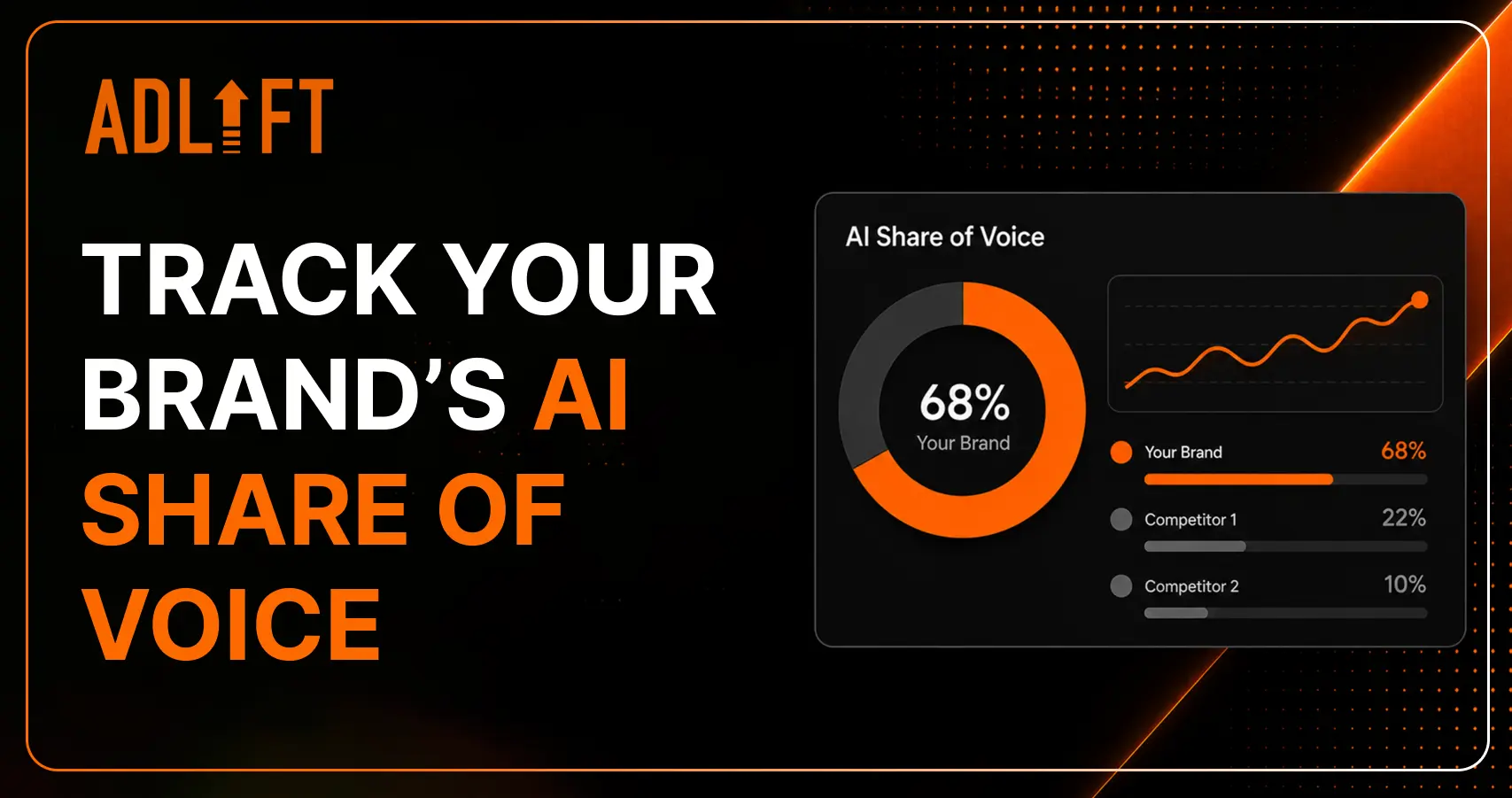
AI Share of Voice (AI SOV) measures a brand’s visibility relative to its competitors across a defined set of prompts, topics, and AI platforms. It helps quantify how prominently a brand appears within generative search results for relevant queries and provides a consistent way to track visibility across AI engines.
| Metric | What it Measures |
| Mention Share | How often your brand is mentioned relative to competitors |
| Citation Share | Your share of cited sources or URLs |
| Prompt Coverage | Percentage of tracked prompts where your brand appears |
| AI Share of Voice | Relative brand visibility across the tracked competitive set |
| Sentiment | How the brand is described when mentioned |
| Unique Citations | Number of distinct sources/domains associated with visibility |
| Platform Visibility | Visibility across ChatGPT, Gemini, Perplexity, Google AI, etc. |
Traditional Share of Voice vs. AI Share of Voice
Traditional Share of Voice tracked paid impression share or simple keyword ranks on a static page. Brand visibility in AI search operates on real-time synthesized answers drawn from dynamic web sources.
AI recommendations act as a pre-qualification layer for modern buyers. They influence consideration before a prospect ever clicks a link, rendering classic impression tracking incomplete.
How to calculate AI Share of Voice:
You can calculate AI Share of Voice using the following formula:
AI Share of Voice = (Your AI mentions ÷ Total AI mentions across all brands in your category) × 100
Example:
Suppose you track 100 relevant AI-generated responses across selected prompts and find that your brand is mentioned 25 times. Across all brands in your category, there are 100 total brand mentions.
AI Share of Voice = (25 ÷ 100) × 100 = 25%
This means your brand accounts for 25% of the total AI mentions recorded across the defined prompts, topics, and AI platforms.
Step 1: Build a Comprehensive AI Prompt Library
Curating a prompt library requires mapping real user discovery workflows instead of relying on isolated short-tail keywords.
Categorizing Prompts by Search Intent
Category & Informational Prompts: “What are the top platforms for [industry]?”
Comparison Queries: “[Your Brand] vs. [Competitor A] vs. [Competitor B]”
Best-Of & Recommendation Queries: “Best [category] tools for enterprise in 2026”
Use-case & Problem-first Queries: “How to solve [specific pain point] with software”
Determining Sample Size and Platform Selection
Start with a focused set of prompts that represents your priority topics, use cases, funnel stages, and customer questions. Expand the library over time as you identify content gaps, emerging pain points, and new query patterns.
Then segment prompts by: Topic × Intent × Funnel Stage × Persona × Platform
Platform choice directly shapes your tracking accuracy. According to industry data, ChatGPT drives 77.97% of global AI referral traffic, while Perplexity drives 15.10%. Prioritize these platforms along with Google AI Overviews (AIO), Gemini, and Claude.
Step 2: Data Extraction and Response Capture
Once your prompt library is ready, you need a systematic method for capturing raw model outputs.
Manual Auditing vs. Automated Tracking
Manual auditing involves running selected prompts through conversational interfaces and recording outputs for analysis. It can help establish an initial baseline and provide qualitative context, but maintaining consistent tracking becomes more resource-intensive as the prompt library, platforms, and review frequency grow.
Automated tracking uses specialised technology to run prompts across multiple Large Language Models (LLMs) and capture results systematically. It can support more frequent monitoring, structured citation capture, competitive comparisons, and historical analysis across larger datasets.
| Factor | Manual Tracking | Automated Tracking |
| Scale | Best suited to smaller prompt sets | Supports larger prompt libraries |
| Consistency | More susceptible to inconsistent execution | Prompts can be executed systematically |
| Frequency | Time-intensive to repeat | Easier to run on a recurring schedule |
| Citation Capture | Requires manual logging | Can automate citation collection |
| Competitive Analysis | Labor-intensive | Easier to compare multiple brands |
| Historical Tracking | Requires manual records | Enables structured trend analysis |
Automated AI SOV Monitoring with Tesseract
As AI search visibility changes across prompts, platforms, and competitors, periodic manual checks can make it harder to maintain consistent measurements over time. Automated tracking helps teams monitor a defined prompt set at regular intervals, organize results systematically, capture changes in brand visibility and citations, and identify competitive shifts more efficiently.
At scale, AI visibility tracking requires consistent prompt execution and historical measurement across platforms. Tesseract by AdLift tracks brand mentions, citations, Share of Voice, sentiment, and visibility trends across AI search experiences, allowing teams to compare performance over time and against competitors.
Logging Response Nuances Beyond Simple Mentions
Learning how to track brand mentions in AI requires looking past binary yes-or-no appearances.
Positioning: Record whether your brand appears first, in the middle, or at the end of the answer.
Citation Links: Track whether the model provides a direct link to your domain as a primary source.
Sentiment & Context: Classify references as positive, neutral, or negative to protect brand equity.
Step 3: Calculating and Benchmarking Your AI Visibility
Raw outputs must be converted into clear metrics to drive high-impact marketing decisions.
Aggregate SOV vs. Platform-specific SOV
Segmenting scores across different engines helps you spot channel discrepancies. For instance, you can analyze why Gemini cites your platform while ChatGPT omits it entirely.
Evaluating aggregate scores alongside platform-specific metrics highlights AI visibility tracking gaps where competitors currently dominate generative summaries.
Setting Category Targets and Benchmarks
Establish realistic market baselines by running your prompt library against top category rivals.
Track changes over time to evaluate whether AI visibility improves following content, SEO, and digital PR initiatives.
Step 4: Strategic Optimization Based on Tracking Data
Measurement is only valuable when it leads to clear content and PR optimization workflows.
Closing Topic and Source Gaps
Create targeted assets for high-value prompts where generative engines currently omit your brand.
Expand your presence on third-party review sites, digital publications, and industry forums that AI platforms cite most frequently. Increasing overall digital Share of Voice in AI search can involve building visibility across the sources and content that AI systems may draw on when generating responses.
Improving Sentiment and Reference Context
Correct outdated product specifications, old pricing models, or inaccurate feature details cited by conversational agents.
Strengthen demonstrable Experience, Expertise, Authoritativeness, and Trustworthiness (E-E-A-T) through expert authorship, original research, accurate information, transparent sourcing, and credible references.
Improve Your Brand’s AI Search Visibility Today
Tracking generative visibility bridges the gap between content production and modern search performance. By constantly monitoring prompt responses, capturing citation links, and refining source context, you ensure your business stays visible when buyers ask AI for recommendations.
Ready to claim your place in conversational search? Build your initial prompt framework today, or sign in to Tesseract by AdLift to run an automated baseline audit for your brand right now.